Permutation and Combination

Permutation & Combination
Counting is one of the most fundamental skills in mathematics and computer science. Whether you're building a password validator, generating test cases, or solving a probability problem — two concepts sit at the heart of it all: Permutation and Combination. Let's break them down clearly, understand where they differ, and then dive into the elegant recursive algorithm that generates all permutations of a string.
1. Permutation — When Order Matters
A permutation is an arrangement of items where the order in which you place them matters.
Imagine you have three letters: A, B, C. How many ways can you arrange all three?
ABC, ACB, BAC, BCA, CAB, CBA → 6 arrangements
Order matters.
Selecting and arranging items.
Formula
Where:
n = total number of items
r = number of items being arranged
n! = n factorial = n × (n−1) × (n−2) × ... × 1
Example: Arrange 3 letters from {A, B, C, D}
Think of permutations as filling numbered seats — seat 1, seat 2, seat 3 all matter.
2. Combination — When Order Does NOT Matter
A combination is a selection of items where order is irrelevant. You only care about which items are chosen, not how they are arranged.
Choosing a team of 3 from {A, B, C, D} — the team {A, B, C} is the same as {C, B, A}.
Order does not matter.
Only selecting items.
Formula
Example: Choose 3 from {A, B, C, D}
Think of combinations as picking a committee — it doesn't matter who was picked first.
3. The Relationship Between P and C
Permutation and Combination are deeply related. Every combination can generate multiple permutations by rearranging its selected elements:
Or equivalently:
Intuition: When you go from a combination to a permutation, you multiply by r!r! r! — the number of ways to arrange the rr r chosen items. Going the other way, you divide out all those redundant orderings.
4. Quick Comparison Table
Feature | Permutation | Combination |
|---|---|---|
Order matters? | Yes | No |
Formula | n! / (n−r)! | n! / r!(n−r)! |
ABC ≠ CBA? | True | False (same set) |
Use case | Passwords, rankings | Teams, selections |
P vs C for same n,r | Always ≥ C | Always ≤ P |
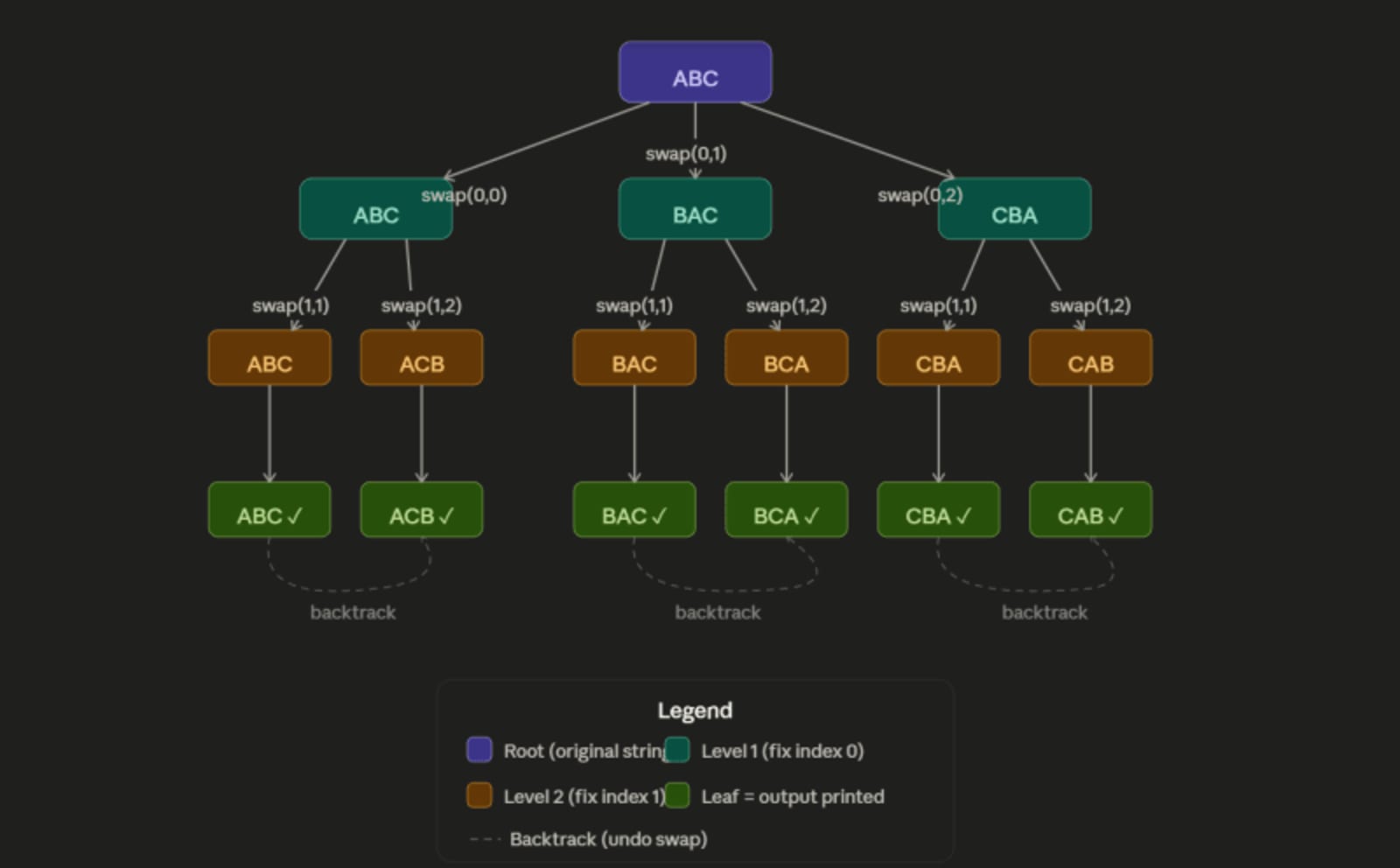
5. The Recursive Permutation Algorithm
void permute(char arr[], int i, int n) {
    if(i == n){
        print(arr);
        return;
    }

    for (int j = i; j<= n; j++) {
        swap(arr[i], arr[j]);
        permute(arr, i + 1, n);
        swap(arr[i], arr[j]); // backtrack undo the swap
    }
}
Recursion tree for permutation of the string "ABC"
Related Notes
External Resources
Permutation (Wikipedia) — https://en.wikipedia.org/wiki/Permutation
Combination (Wikipedia) — https://en.wikipedia.org/wiki/Combination
Recursion (Wikipedia) — https://en.wikipedia.org/wiki/Recursion_(computer_science)
Backtracking Algorithms (GeeksforGeeks) — https://www.geeksforgeeks.org/backtracking-algorithms/