Merge Sort

Merge Sort
Merge Sort is a Divide and Conquer algorithm.
Given an array
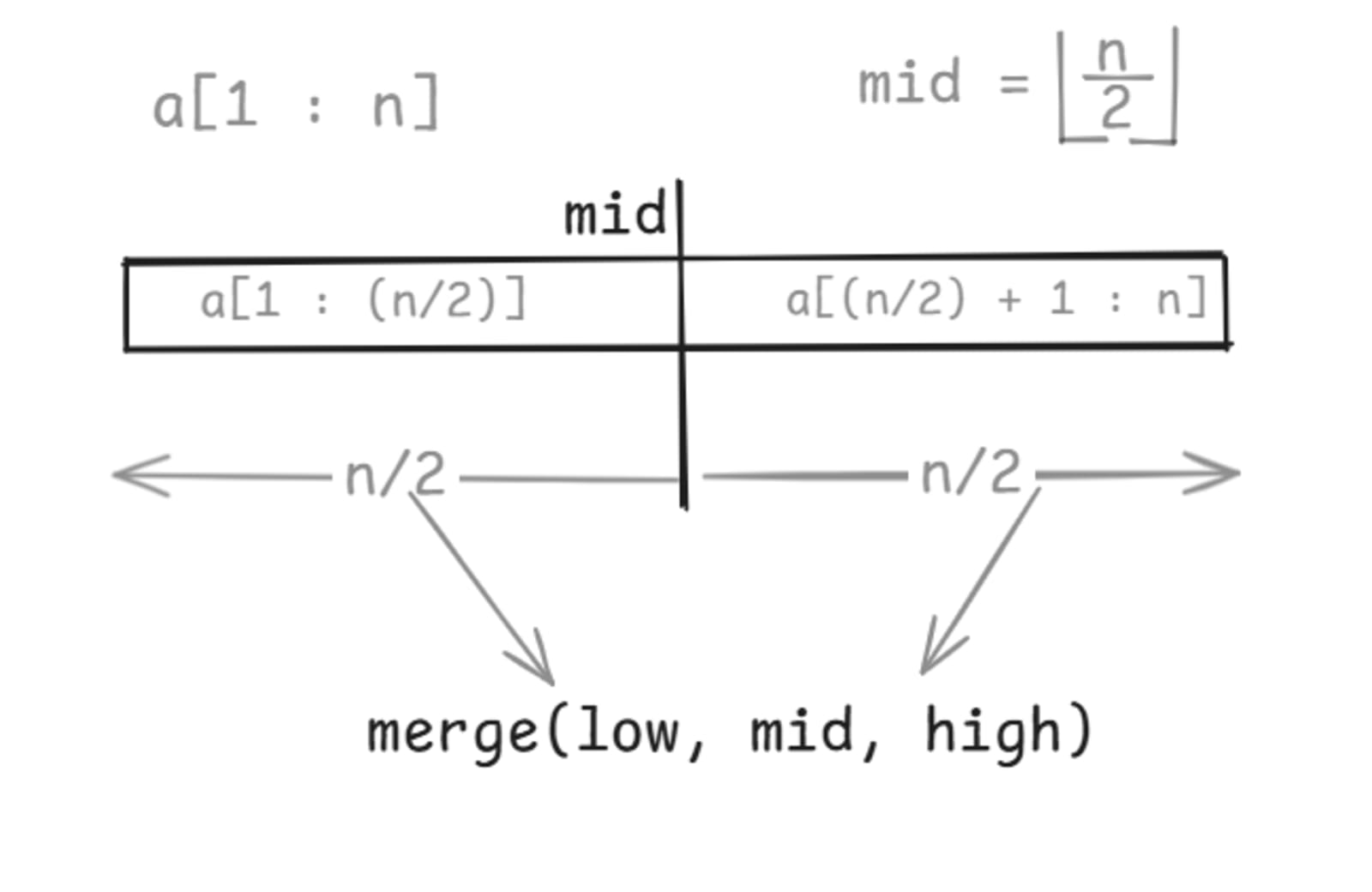
a[1…N], merge sort works as follows:Divide the array into two equal halves.
Recursively apply merge sort to both halves.
Use the merge operation to combine the two sorted halves into one sorted array.
Algorithm (Merge Sort)
MERGE_SORT(low, high)
1. if low < high
2.     mid = (low + high) / 2
3.     MERGE_SORT(low, mid)
4.     MERGE_SORT(mid + 1, high)
5.     MERGE(low, mid, high)
Merge Operation
a[low…high]is a global array, wherea[low…mid]anda[mid+1…high]are the sorted subarrays residing within it.MERGE(low, mid, high)will merge these sorted subarrays into a single sorted arrayb[]is an auxiliary array used for merging.
i = low
j = mid + 1
h = low
while(n ≤ mid && j ≤ high) do
{
    if(a[h] ≤ a[j]){
        b[i] = a[h++]
    }
    else{
        b[i] = a[j++]
    }
    i = i + 1
}

// left subarray exhausted
if(h > mid){
    for k = j to high do
    {
        b[i] = a[k]
        i = i + 1;
    }
}

// right subarray exhausted
if(h > mid){
    for k = h to mid do
    {
        b[i] = a[k]
        i = i + 1;
    }
}

// copy the auxillary array b to main array
for k = low to high do
{
    a[k] = b[k]
}
Time Complexity of the Merge Operation
When merging two sorted subarrays, each of size n/2:
Minimum Comparisons:
Occurs when every element of the first subarray is less than or equal to every element of the second subarray (or vice versa).
In this case, only n/2 comparisons are required.
Maximum Comparisons:
Occurs when elements are compared alternately from both subarrays until one subarray is exhausted, leaving exactly one element in the other subarray.
In this case, up to n – 1 comparisons are required.
Merge Sort Recurrence Relation
Let T(n) = time taken by merge sort to sort array
a[1…n].Computing the mid index takes constant time →
c₁.Dividing into two halves:
Each half has size
n/2.Recursive calls take
2T(n/2).
Merging two sorted halves takes O(n) time →
c₂n.
🔹 Recurrence Relation for Merge Sort
Base case:
Simplified Form
Since constants don’t matter in asymptotic notation:
2T(n/2)→ recursive cost of sorting two halvesDn→ merging costc₁→ cost of computing mid (constant)
So,
Limit Test for
Define:
Now,
Hence,
So recurrence reduces to:
Recursive Tree
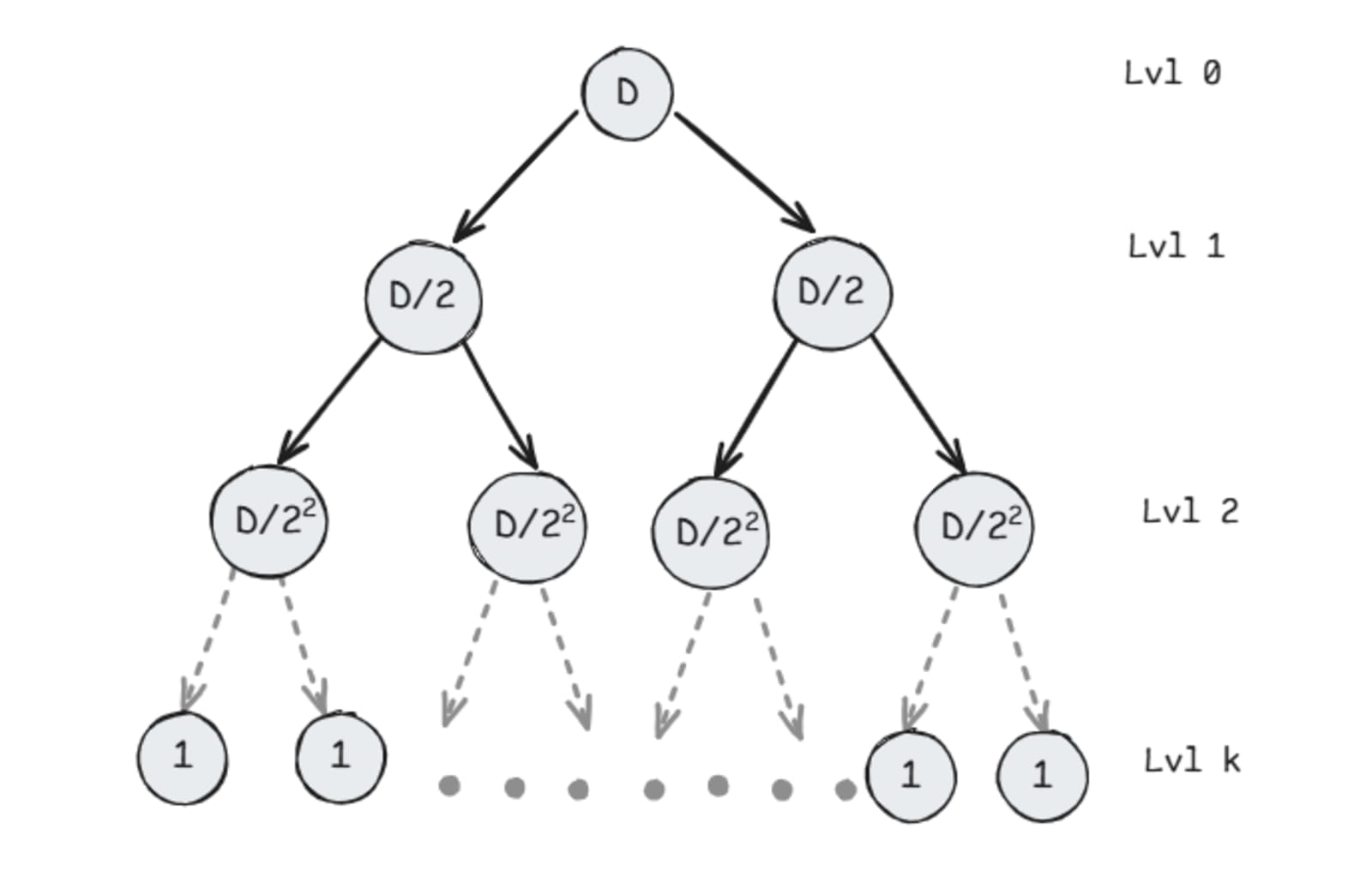
Recursive Tree Expansion
Level 0 →
Level 1 →
Level 2 →
…
Level →
Leaves →
is the number of internal levels of the tree,
is the total non-recursive work per level (e.g ),
is the number of leaves and is the cost at a leaf.
Since and
Asymptotic Analysis
So,
Therefore: