DAA Assignment 1

Algorithm Analysis: Comparing Growth Rates of n², nlog₂n, and 3ⁿ
In algorithm analysis, comparing the growth of functions like , , and helps us understand their time complexity and efficiency as input size increases. Among these, grows the slowest and is commonly seen in efficient algorithms like Merge Sort, while grows faster and appears in less efficient approaches such as simple nested loops. On the other hand, grows exponentially and increases extremely rapidly, making algorithms with this complexity impractical for even moderately large inputs. Therefore, in terms of growth rate, is the most efficient, followed by , and is the least efficient for large values of .
For a deeper understanding of how these functions are formally classified, refer to Asymptotic Notation and Comparison of Two Functions.
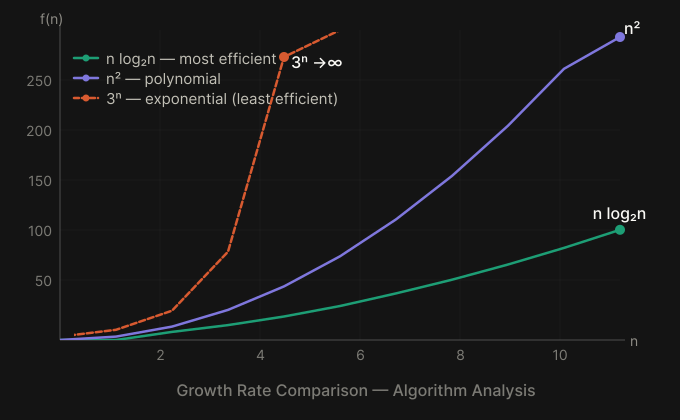
Compare the Growth of the Functions , , and
Case 1: Comparing vs
Let:
This is an form, so apply L'Hôpital's Rule.
Apply L'Hôpital's Rule
Differentiate the numerator:
Differentiate the denominator:
Using the product rule on :
Apply L'Hôpital's Rule Again
Case 2: Comparing vs
Let:
This is an form, so apply L'Hôpital's Rule.
Apply L'Hôpital's Rule
Differentiate the numerator:
Differentiate the denominator:
Apply L'Hôpital's Rule Again
Result
Function | Order of Growth |
|---|---|
Highest | |
2nd Highest | |
Smallest (Most Efficient) |
This ranking directly aligns with the principles of asymptotic analysis. Algorithms with complexity, such as Merge Sort and Quick Sort, are significantly more scalable than those with or exponential time complexity. Understanding these differences is foundational to the Design and Analysis of Algorithms.
For practice with related concepts, see DAA Previous Year Questions and Binary Search Recurrence Relation.
For an authoritative reference on algorithm complexity, see the Big-O Cheat Sheet and Khan Academy's explanation of asymptotic notation.