Perceptron

Perceptron
Think of the Perceptron as a simple decision-maker—it looks at inputs, weighs their importance, and makes a yes-or-no judgment. It was one of the first steps toward building intelligent systems and still plays a crucial role in understanding how neural networks work today. By learning how to draw a boundary between different classes of data, the perceptron forms the foundation for more advanced models used in real-world applications.
Definition:
A Perceptron is an artificial neuron in which the activation function is a threshold function.
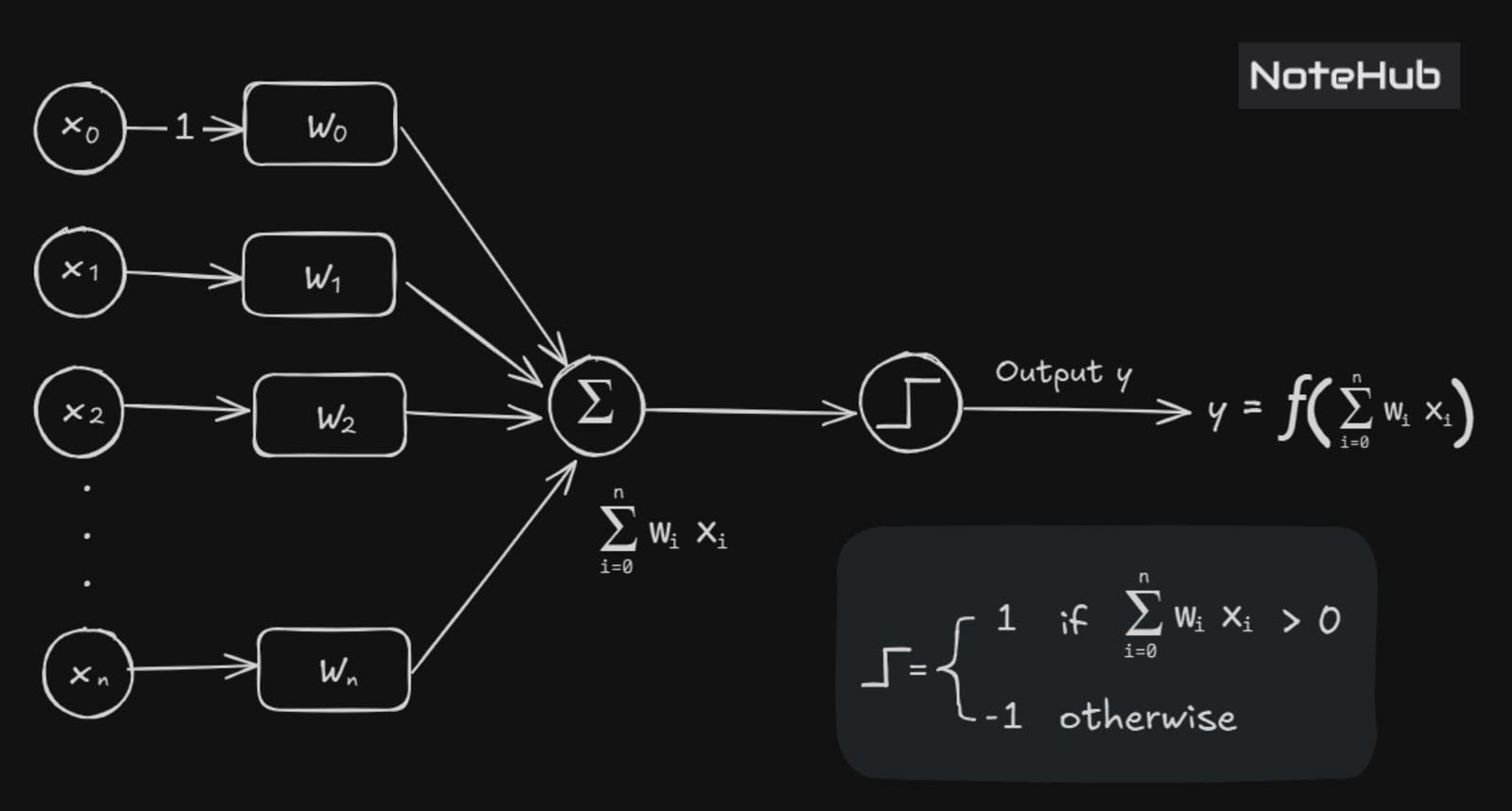
Terminology:
= input signals
= associated weights
= Bias input (typically set to 1).
= Bias weight (adjusts activation threshold).
= Weighted sum of inputs.
= Activation function (determines output).
= Final output signal.
The neuron is called as perceptron if the output of the neuron is given by the following functions
This is a step function — if the weighted sum exceeds the threshold, the neuron "fires" (outputs 1), else it outputs 0.
Perceptron Learning Algorithm
In the algorithm, we use the following notations
Symbol | Description |
|---|---|
Number of input variables | |
output for input vector | |
The | |
Desired output for input | |
Value of | |
Bias input (always 1) | |
Weight for the | |
Weight for the |
Algorithm Steps
Step 1: Initialization
Initialize the weights:
Can be initialized to 0 or small random values.
Also, initialize a threshold (bias term).
Step 2: Training (for each training sample)
For each example in the training set .
perform the following step over the input and desired output
Compute the output
This is the predicted output of the perceptron after processing input using the current weights at iteration . The perceptron computes this using:
Update weights for each using:
Step 3: Repeat Until Convergence
Repeat Step 2 until either:
The average error per iteration is less than a predefined threshold:
OR
A maximum number of iterations is reached.