LangChain vs Vector Database

LangChain vs Vector Database: Understanding the Difference in Modern AI Applications
As AI applications powered by Large Language Models (LLMs) continue to grow, two terms frequently appear in discussions around AI architecture:
LangChain
Vector Database
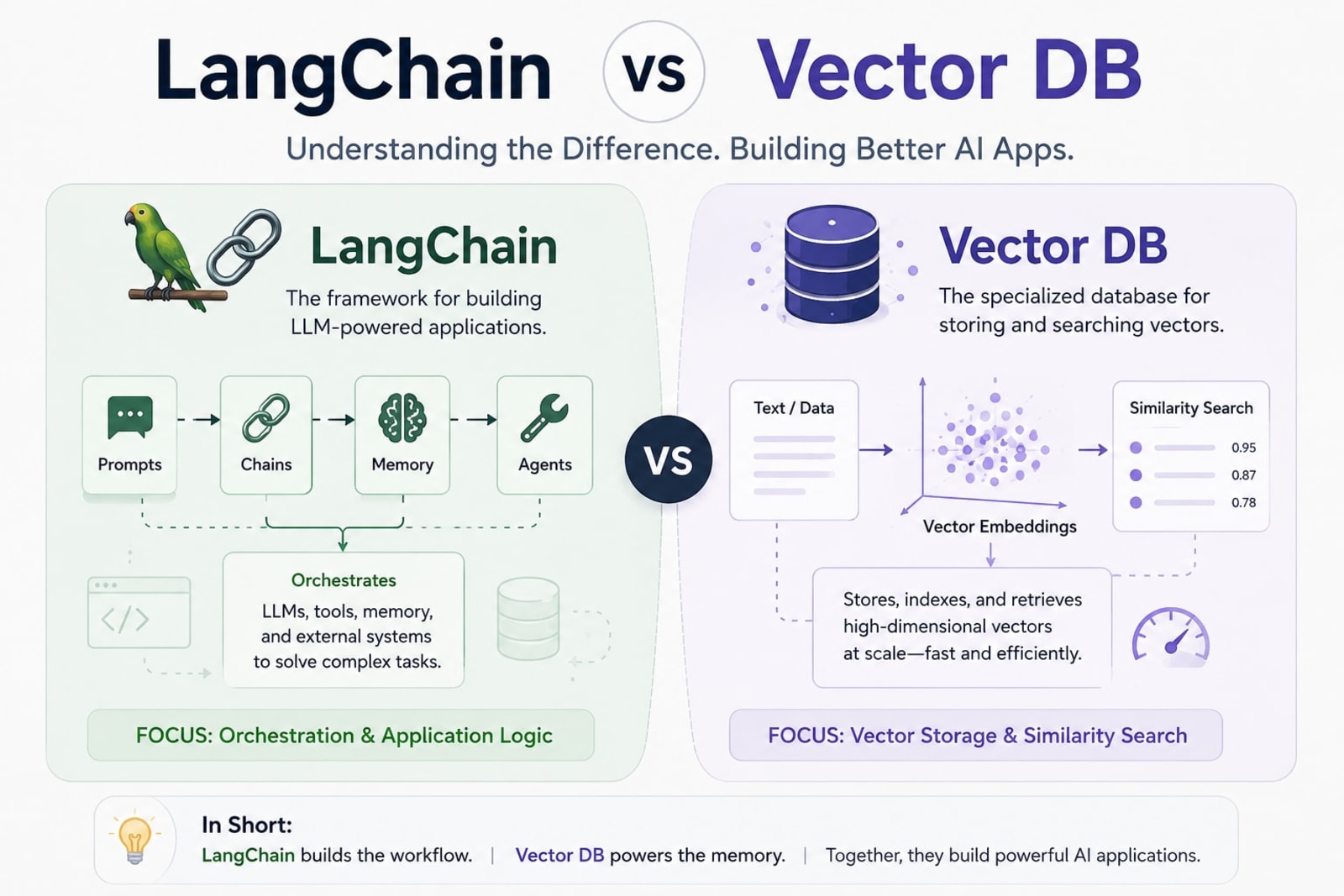
Many beginners assume they are competing technologies. In reality, they solve completely different problems and often work together in the same AI system.
If you are building AI chatbots, RAG pipelines, AI assistants, or enterprise search systems, understanding the difference between LangChain and vector databases is essential.
In this blog, we’ll explore:
What LangChain is
What a Vector Database is
Key differences
How they work together
Use cases
Which one you actually need
What is LangChain?
LangChain is an open-source framework designed to help developers build applications powered by Large Language Models (LLMs).
It acts as the “orchestration layer” of an AI application.
Think of LangChain as the brain that coordinates:
Prompts
AI models
Memory
APIs
Tools
Retrieval systems
Workflows
Instead of manually connecting all components, LangChain provides reusable building blocks for AI development.
What Can LangChain Do?
LangChain helps developers:
1. Build AI Chatbots
Create conversational AI systems with memory and context awareness.
2. Create RAG Pipelines
Connect LLMs to external knowledge sources like PDFs, websites, and databases.
3. Integrate APIs and Tools
Allow AI agents to:
Search the web
Access databases
Send emails
Execute functions
4. Manage Prompt Chains
Build multi-step reasoning workflows.
Example:
User Query
   ↓
Search Knowledge Base
   ↓
Summarize Results
   ↓
Generate Final Response
5. Add Memory
Enable chatbots to remember previous conversations.
What is a Vector Database?
A Vector Database is a specialized database designed to store and search vector embeddings efficiently.
It is used primarily for:
Semantic search
Similarity matching
Retrieval-Augmented Generation (RAG)
What are Vector Embeddings?
Before understanding vector databases, you need to understand embeddings.
Embeddings are numerical representations of text, images, or other data.
For example:
“car”
“vehicle”
“automobile”
would have similar vector representations because they mean similar things.
This allows AI systems to search based on meaning instead of exact keywords.
What Does a Vector Database Do?
A vector database stores embeddings and retrieves the most semantically relevant information.
Example workflow:
User Question
   ↓
Convert Query to Embedding
   ↓
Search Vector Database
   ↓
Retrieve Similar Documents
Popular Vector Databases
Some popular vector databases include:
Pinecone
Weaviate
ChromaDB
Milvus
FAISS
Qdrant
These tools are optimized for high-speed similarity search.
LangChain vs Vector Database: Core Difference
This is the most important concept:
LangChain is a Framework
It helps orchestrate and manage AI workflows.
Vector Database is a Storage + Retrieval System
It stores and retrieves embeddings efficiently.
They are not competitors.
They are complementary technologies.
Simple Analogy
Imagine building a smart AI librarian system.
LangChain
Acts like the librarian who:
Understands the question
Decides what to search
Organizes the workflow
Talks to the user
Vector Database
Acts like the bookshelf system that stores books in a searchable way.
The librarian uses the bookshelf to find information.
Architecture Example
Here’s how they usually work together in a RAG system:
User Question
   ↓
LangChain
   ↓
Embedding Model
   ↓
Vector Database Search
   ↓
Retrieve Relevant Chunks
   ↓
LLM Generates Response
In this setup:
LangChain manages the workflow
Vector DB stores searchable knowledge
LLM generates the answer
Key Differences Between LangChain and Vector Database
Feature | LangChain | Vector Database |
|---|---|---|
Type | Framework | Database |
Purpose | AI workflow orchestration | Embedding storage & retrieval |
Handles prompts | Yes | No |
Stores embeddings | No | Yes |
Semantic search | Through integrations | Core functionality |
Connects LLMs | Yes | No |
Memory support | Yes | Limited |
Tool integration | Yes | No |
Primary use case | Building AI apps | Fast similarity search |
Do You Need Both?
In many modern AI systems:
Yes.
Especially for:
RAG applications
AI chatbots
Enterprise search
Knowledge assistants
Example Without Vector Database
You could use LangChain alone with:
Simple keyword search
Small datasets
Hardcoded knowledge
But retrieval quality may suffer.
Example Without LangChain
You could use a vector database directly with custom code.
However:
Workflow management becomes difficult
Prompt handling gets messy
Scaling becomes harder
When to Use LangChain
Use LangChain when you need:
AI workflow orchestration
Multi-step reasoning
Agent systems
Tool calling
Prompt chaining
Memory
RAG pipelines
When to Use a Vector Database
Use a vector database when you need:
Semantic search
Document retrieval
Embedding storage
Similarity matching
Large-scale searchable knowledge bases
Real-World Use Cases
1. AI Customer Support
LangChain
Manages chatbot conversations and workflow.
Vector DB
Stores support documents and FAQs.
2. Enterprise Knowledge Assistant
LangChain
Coordinates retrieval and response generation.
Vector DB
Stores company policies and internal documentation.
3. Legal AI Systems
LangChain
Builds reasoning pipelines.
Vector DB
Retrieves relevant legal cases and contracts.
4. Healthcare AI
LangChain
Handles medical query workflows.
Vector DB
Stores medical research embeddings.
Popular LangChain Integrations
LangChain integrates with:
OpenAI
Anthropic
Hugging Face
Pinecone
Weaviate
ChromaDB
Redis
SQL databases
This flexibility makes it widely used in AI engineering.
Challenges with LangChain
Although powerful, LangChain also has challenges:
1. Complexity
Large workflows can become difficult to manage.
2. Frequent Updates
The ecosystem evolves rapidly.
3. Debugging Difficulties
Multi-step chains may be hard to troubleshoot.
Challenges with Vector Databases
1. Retrieval Accuracy
Poor embeddings can reduce search quality.
2. Infrastructure Costs
Large-scale vector search can become expensive.
3. Data Chunking Issues
Improper chunking impacts retrieval performance.
Alternative Frameworks to LangChain
Some alternatives include:
LlamaIndex
Haystack
Semantic Kernel
DSPy
Each has different strengths depending on use cases.
Future of AI Architecture
Modern AI systems are increasingly built around:
LLMs
RAG pipelines
Vector search
AI agents
Workflow orchestration
LangChain and vector databases are becoming foundational technologies in this ecosystem.
As AI applications mature, the combination of:
orchestration frameworks
retrieval systems
specialized models
will define next-generation AI products.
Final Thoughts
LangChain and vector databases are not competing technologies — they serve different but complementary roles in AI systems.
In simple terms:
LangChain
Controls the workflow and intelligence orchestration.
Vector Database
Stores and retrieves semantically relevant knowledge.
If you are building:
AI chatbots
RAG systems
Enterprise AI assistants
Knowledge search tools
you will likely use both together.
Understanding how these components interact is essential for designing scalable and efficient AI applications in 2026 and beyond.
FAQs
Is LangChain a vector database?
No. LangChain is an orchestration framework, not a database.
Can I use LangChain without a vector database?
Yes, but retrieval quality and scalability may be limited.
Which vector database is best?
Popular options include Pinecone, Weaviate, ChromaDB, and Qdrant. The best choice depends on scale and use case.
Does LangChain store embeddings?
No. Embeddings are usually stored in external vector databases.
Are vector databases necessary for RAG?
In most production-grade RAG systems, yes.