LSTM (Long Short term memory)


LSTM (Long Short-Term Memory)
LSTM is a special type of recurrent neural network designed to efficiently learn and retain long-term dependencies in sequential data. Traditional RNNs struggle with the vanishing and exploding gradient problem. LSTM overcomes this limitation by introducing a unique memory-cell structure that selectively writes or forgets information as needed.
The core components of LSTM lie in its gating system: the forget gate, the input gate, and the output gate. These gates regulate the flow of information, enabling the network to focus on reliable data while discarding unnecessary details.
The internal architecture of the LSTM Unit
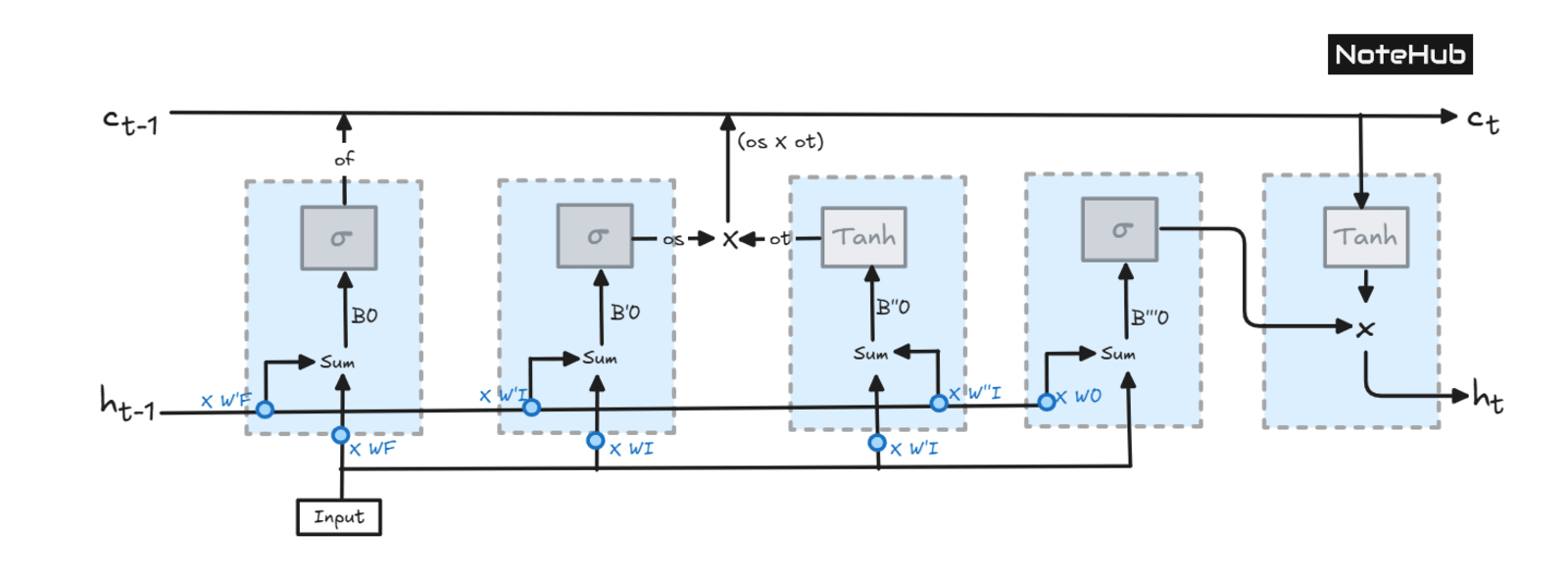
Components
LSTMs use three gates to control how information flows through the network and to manage long-term memory.
1. Forget Gate
Decides what information from the previous cell state to remove.
Uses a sigmoid (0–1) to keep (1) or forget (0) information.
2. Input Gate
Determines what new information to add to the cell state.
Sigmoid selects which values to update.
tanh creates candidate new information.
3. Output Gate
Controls what part of the cell state becomes the output.
Uses sigmoid to filter the state and tanh to scale the final output.
Summary:
These gates enable LSTMs to remember important information and forget irrelevant details, allowing them to effectively capture long-term dependencies in sequence tasks.
RNN vs LSTM Comparison
Feature | RNN | LSTM |
|---|---|---|
Architecture | Simple structure with hidden state. | Complex structure with cell state and a gating mechanism. |
Gradient Issue | Prone to vanishing and exploding gradients in long sequences. | Mitigates gradient issues using cell state for better information flow. |
Memory Management | Relies only on hidden state, often losing long-term dependencies. | Uses cell states + gates to retain relevant long-term information. |
Sequential Handling | Works well for short sequences but struggles with long ones. | Efficiently handles both short and long sequences. |
Learning Mechanism | Simple backpropagation through time (BPTT). | Incorporates gate mechanisms (forget, input, output) for flexible learning. |
Flexibility | Suitable for basic tasks (e.g., sentiment analysis). | Suitable for complex tasks (e.g., machine translation, speech synthesis). |
Training Stability | Training may become unstable due to gradient problems. | Gates ensure stable training even with long sequences. |
Applications of LSTM
Speech Recognition
LSTM plays a vital role in converting spoken words into text by processing sequential audio data. Their ability to retain long-term dependencies makes them effective in identifying patterns in speech signals, improving the accuracy of automatic speech recognition systems.Natural Language Processing (NLP)
LSTMs are extensively used in NLP tasks like sentiment analysis, language translation, and text summarization. They capture the context and semantics of words over long sentences, enabling applications like chatbot responses, email sorting, and more.Forecasting
LSTMs are widely used in analyzing sequential data over time, making them a preferred choice for forecasting trends in finance, marketing, energy consumption, and weather prediction.Healthcare Data Analysis
LSTMs analyze time-series data such as patient vitals, ECG signals, and medical histories to predict diseases, monitor health conditions, and recommend personalized treatments.
Further Reading & Related Notes
On NoteHub
Core Prerequisites
Artificial Neural Networks — foundational architecture before diving into LSTM
Types of Learning Models — where sequence models fit in the ML landscape
Gradient Descent — the optimization engine behind LSTM training
Sibling Architectures
Recurrent Neural Network (RNN) — the predecessor LSTM was built to fix
Convolutional Neural Network (CNN) — parallel deep learning architecture for spatial data
Gaussian Mixture Model — probabilistic alternative for sequential pattern modelling
Applied Topics
Natural Language Processing (NLP) — primary application domain of LSTM
Time Series & ARIMA Forecasting — classical forecasting vs LSTM-based forecasting
Independent Component Analysis (ICA) — signal separation used alongside LSTM in audio/speech tasks
Ensemble Learning — combining LSTM with other models for stronger predictions
XGBoost — popular alternative for tabular time-series forecasting
Around the Web
Papers & Research
Original LSTM Paper — Hochreiter & Schmidhuber (1997) — the paper that introduced LSTM
Deep Learning in Healthcare — Nature (2019) — clinical applications of LSTM and deep learning
Tutorials & Guides
Understanding LSTMs — Colah's Blog — the most cited visual explanation of LSTM internals
Working with RNNs & LSTMs — TensorFlow — official implementation guide in Keras
LSTM in PyTorch — PyTorch Docs — API reference and usage examples
Deeper Concepts
The Vanishing Gradient Problem — Towards Data Science — why RNNs fail and how LSTM solves it
Sequence Modelling: Recurrent & Convolutional Nets — Stanford CS224N — university-level coverage of LSTM in NLP context