Text Mining

Text Mining
Definition
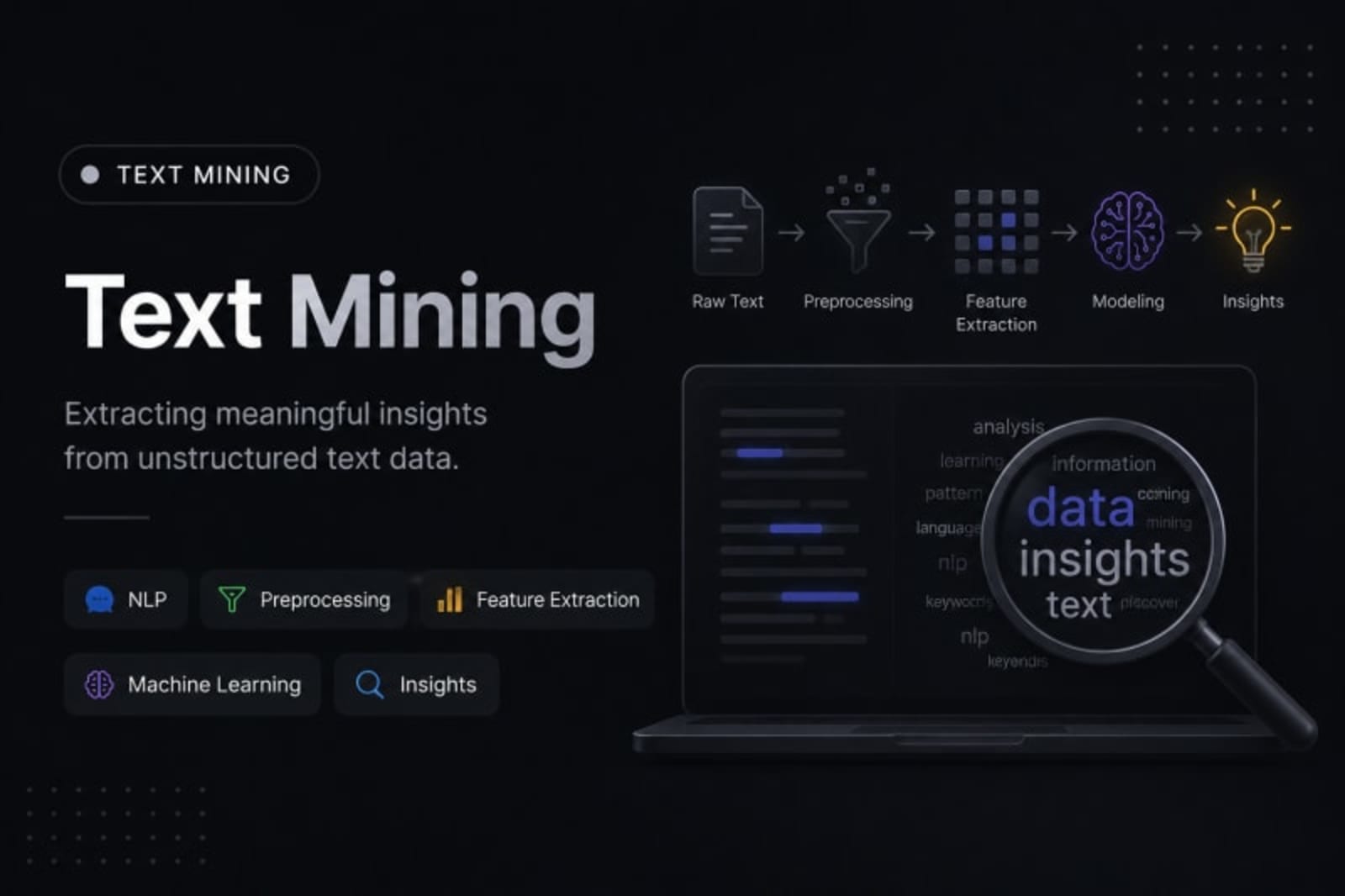
Text Mining (also called Text Analytics) is the process of extracting meaningful, structured information from unstructured textual data. It applies Natural Language Processing (NLP), statistical methods, and machine learning techniques to discover patterns, trends, and insights from large volumes of text.
Text data sources include: emails, social media posts, articles, reviews, books, medical records, legal documents, etc.
Text Mining vs. Data Mining
Feature | Data Mining | Text Mining |
|---|---|---|
Input | Structured data (tables, DBs) | Unstructured text |
Format | Numbers, categories | Natural language |
Techniques | Clustering, classification | NLP, parsing, tagging |
Output | Patterns, rules | Concepts, sentiments, topics |
Text Mining Process / Pipeline
Raw Text → Preprocessing → Feature Extraction → Modeling → Knowledge / InsightsStep 1: Text Preprocessing
Cleaning and preparing raw text before analysis.
Technique | Description | Example |
|---|---|---|
Tokenization | Split text into words/sentences | "Hello world" → ["Hello", "world"] |
Lowercasing | Convert to lowercase | "Data" → "data" |
Stop Word Removal | Remove common words | Remove "is", "the", "a" |
Stemming | Reduce word to root form | "running" → "run" |
Lemmatization | Map word to dictionary form | "better" → "good" |
Noise Removal | Remove punctuation, HTML, URLs | "Hello!!" → "Hello" |
Step 2: Feature Extraction
Converting text into numerical form that machines can process.
1. Bag of Words (BoW) Represents text as a frequency count of words, ignoring grammar and order.
2. TF-IDF (Term Frequency – Inverse Document Frequency) Weights words by how important they are in a document relative to a corpus.
3. Word Embeddings Dense vector representations that capture semantic meaning.
Word2Vec – Predicts context words
GloVe – Global co-occurrence statistics
BERT – Contextual embeddings using transformers
Step 3: Core Text Mining Tasks
1. Information Extraction (IE) Identifying structured information from text.
Named Entity Recognition (NER) – Detects names, places, organizations
Relation Extraction – Finds relationships between entities
2. Text Classification Assigning predefined categories to text documents.
Spam detection
News categorization
Sentiment classification (Positive / Negative / Neutral)
3. Sentiment Analysis Determining the emotional tone behind text.
"The product is amazing!" → Positive
"Terrible service." → Negative
4. Topic Modeling Discovering abstract topics within a collection of documents.
LDA (Latent Dirichlet Allocation) – Most popular algorithm
Each document is a mixture of topics; each topic is a mixture of words
5. Text Summarization Generating concise summaries from large texts.
Extractive – Selects key sentences from original text
Abstractive – Generates new sentences capturing main ideas
6. Information Retrieval Finding relevant documents from a large collection (e.g., search engines).
7. Machine Translation Automatically translating text from one language to another (e.g., Google Translate).
Algorithms Used in Text Mining
Algorithm | Use Case |
|---|---|
Text classification, spam filtering | |
Document categorization | |
Document grouping | |
LDA | Topic modeling |
LSTM / Transformers | Sequence modeling, translation |
BERT / GPT | Advanced NLP tasks |
Applications of Text Mining
Domain | Application |
|---|---|
Business | Customer feedback analysis, brand monitoring |
Healthcare | Mining clinical notes, drug interaction detection |
Finance | News sentiment for stock prediction |
Legal | Contract analysis, case law retrieval |
Education | Plagiarism detection, essay grading |
Social Media | Trend analysis, hate speech detection |
E-commerce | Product review mining, recommendation |
Tools & Libraries
Tool / Library | Language | Purpose |
|---|---|---|
Python | General NLP & text processing | |
Python | Industrial-strength NLP | |
Gensim | Python | Topic modeling, Word2Vec |
Python | Text classification & clustering | |
Python | Transformer models (BERT, GPT) | |
TextBlob | Python | Sentiment analysis, simple NLP |
RapidMiner | GUI | Visual text mining workflows |
Challenges in Text Mining
Ambiguity – Words with multiple meanings (polysemy)
Slang & Abbreviations – Informal language in social media
Multilingual Data – Handling multiple languages
Sarcasm & Irony – Hard to detect computationally
Scalability – Processing millions of documents efficiently
Data Privacy – Sensitive information in text corpora
Summary
Text Mining transforms raw, unstructured language into structured, actionable knowledge. It is a critical component of modern AI systems — from search engines and chatbots to medical diagnosis and financial forecasting. Mastering text mining requires understanding both the linguistic nature of text and the computational tools to process it at scale.