Data Science Basics – Introduction

Data Science Basics – Introduction
What is Data Science?
Data Science is an interdisciplinary field that combines statistics, mathematics, programming, and domain expertise to extract meaningful insights and knowledge from structured and unstructured data. It involves collecting, processing, analyzing, and visualizing data to support decision-making.
Key Components of Data Science
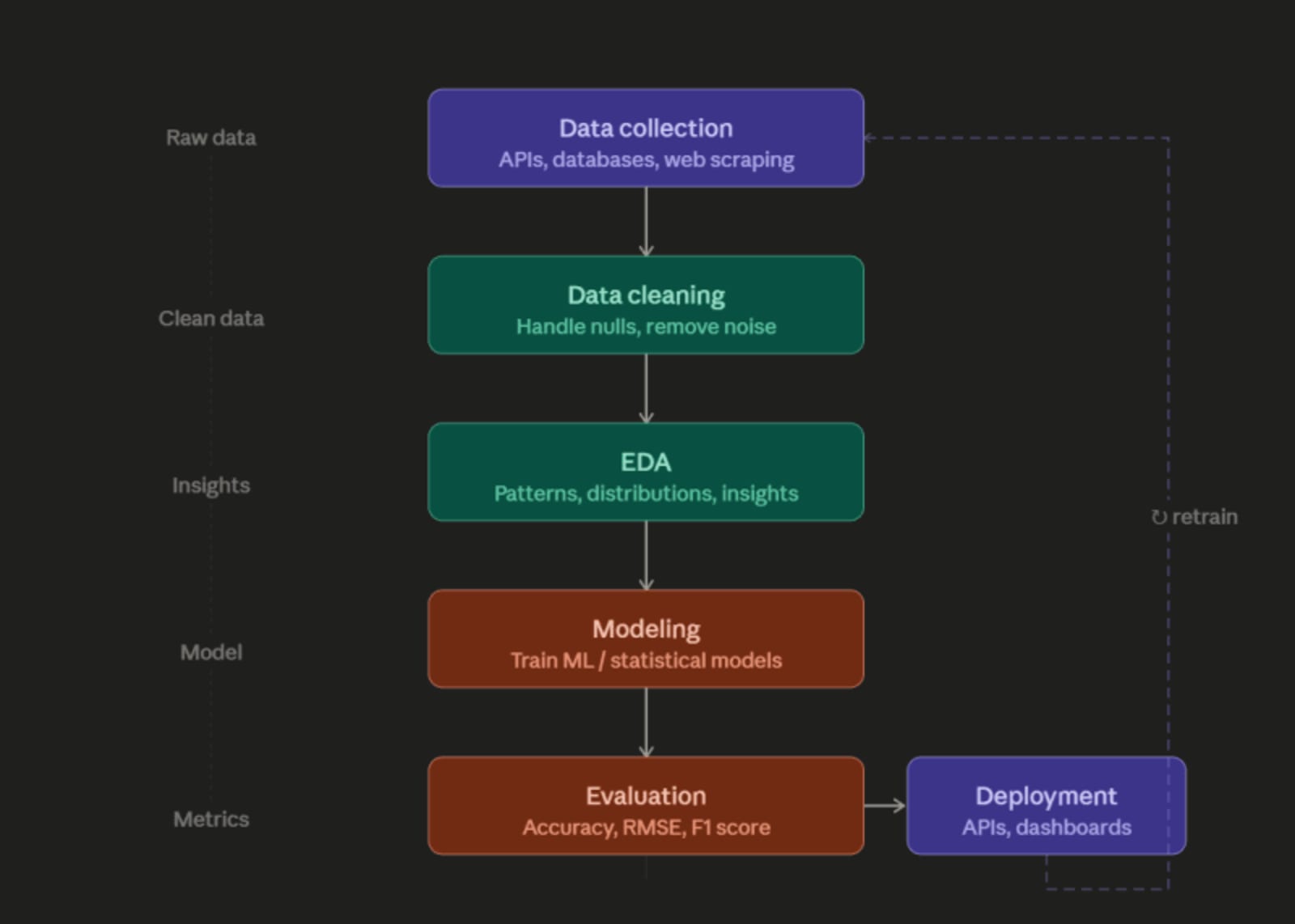
1. Data Collection Gathering raw data from various sources such as databases, APIs, web scraping, sensors, or surveys. The quality and quantity of data directly impact the results.
2. Data Cleaning & Preprocessing Raw data is often incomplete, inconsistent, or noisy. This step involves handling missing values, removing duplicates, correcting errors, and transforming data into a usable format.
3. Exploratory Data Analysis (EDA) Using statistical methods and visualizations (histograms, scatter plots, heatmaps) to understand patterns, trends, and relationships within the data before building models.
4. Modeling & Machine Learning Applying algorithms (linear regression, decision trees, neural networks, etc.) to build predictive or descriptive models that learn from data.
5. Data Visualization & Communication Presenting results through charts, dashboards, and reports using tools like Matplotlib, Tableau, or Power BI to make insights accessible to stakeholders.
Data Science Lifecycle
Tools & Technologies
Category | Tools |
|---|---|
Programming | |
Data Manipulation | Pandas, NumPy |
Visualization | Matplotlib, Seaborn |
Databases | SQL, MongoDB |
Applications of Data Science
Healthcare – Disease prediction, drug discovery
Finance – Fraud detection, stock market analysis
E-commerce – Recommendation systems, customer segmentation
Social Media – Sentiment analysis, trend prediction
Transportation – Route optimization, demand forecasting
Why Data Science Matters
In today's digital age, enormous volumes of data are generated every second. Data Science enables organizations to turn this raw data into actionable intelligence, improve efficiency, reduce costs, and gain a competitive advantage.
Key Takeaway: Data Science is not just about coding or statistics alone — it is the art of asking the right questions and finding answers hidden within data.