What is Pretext JS? How It Fixes Browser Reflow and Makes Text 500x Faster

What is Pretext JS? How It Fixes Browser Reflow and Makes Text 500x Faster
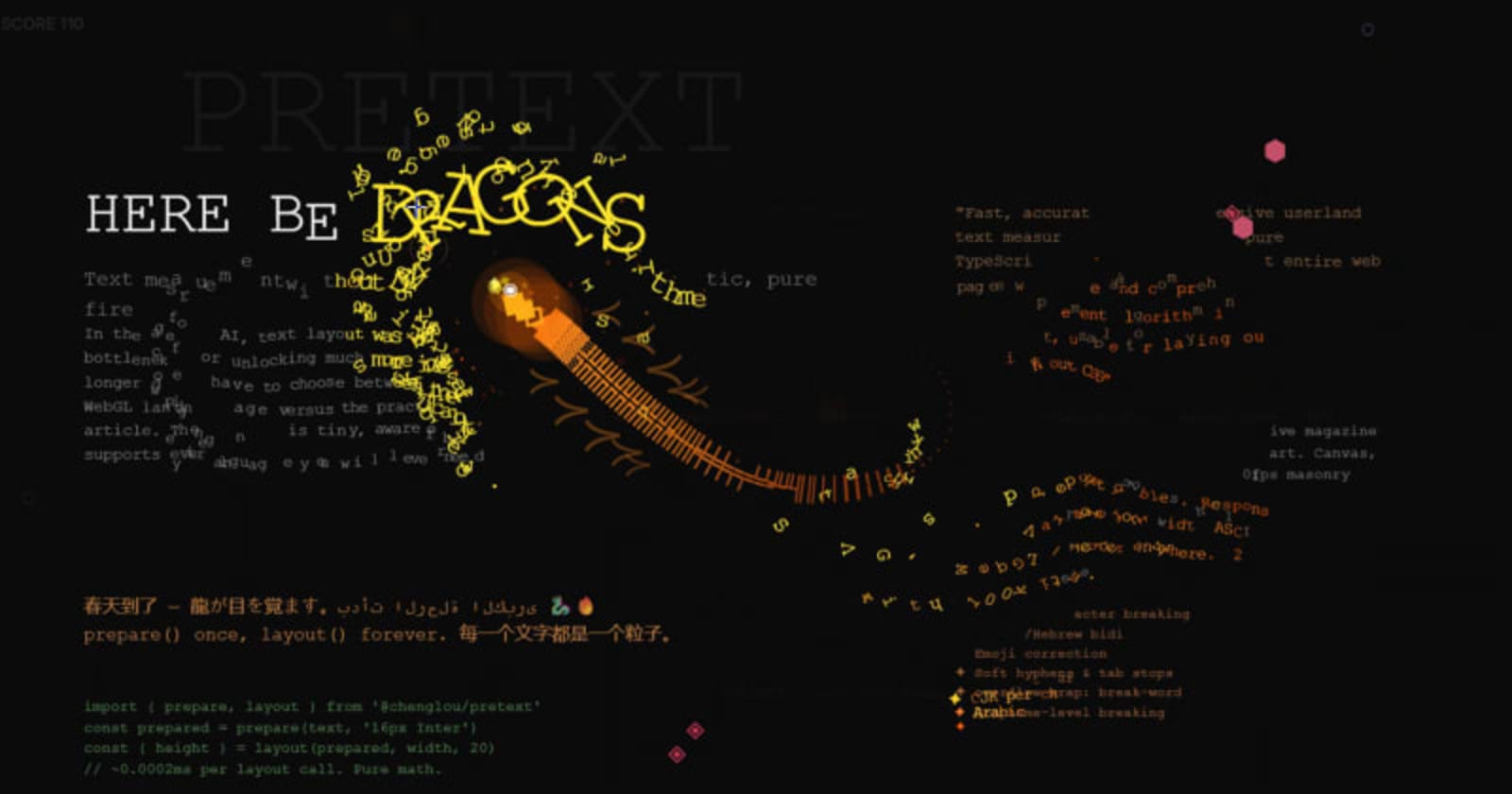
CSS isn’t dead… but one of its biggest limitations just got exposed.
For the last 30 years, browsers have handled text layout using the DOM.
Every time text changes, the browser recalculates layout — a costly process called reflow.
That’s why even today, apps still feel:
laggy
janky
slow under heavy updates
Now, a new library called Pretext JS, created by Cheng Lou, is changing that completely.
👉 It removes the DOM from text layout.
👉 It replaces layout with pure JavaScript calculations.
👉 And in heavy scenarios, it can be hundreds of times faster.
This isn’t just a performance trick…
It’s a completely new way to think about text rendering on the web.
What is Pretext JS?
Pretext JS is a high-performance JavaScript/TypeScript library for multiline text measurement and layout.
Unlike traditional approaches, it:
does NOT use the DOM for measurement
uses the browser’s font engine via Canvas API
calculates layout using pure math
👉 In simple words:
Pretext lets you measure and layout text without triggering browser reflow.
It was open-sourced by Cheng Lou (ex-React core contributor) and quickly gained popularity because it solves a long-standing frontend bottleneck.
The Real Problem: Browser Reflow
Whenever you change or measure text in the DOM:
const height = element.offsetHeight;The browser must:
Recalculate styles
Layout (Reflow) ❌ expensive
Paint
Composite
👉 Even reading layout values triggers reflow.
And if this happens repeatedly (chat apps, animations, lists), you get:
layout thrashing
frame drops
poor UX
This problem has existed for decades because DOM layout is inherently expensive.
How Pretext Fixes This
Pretext takes a completely different approach:
👉 Instead of asking the DOM for layout…
👉 It calculates layout itself.
Core Idea:
Use
canvas.measureText()(same font engine as browser)Cache all word widths
Simulate line wrapping in JavaScript
Result:
❌ No DOM reads
❌ No reflows
✅ Pure arithmetic layout
How Pretext Works (Simple Explanation)
Pretext follows a 2-step architecture:
1️⃣ prepare() → One-time setup
splits text into segments
measures each word using Canvas
caches widths
This step is slightly expensive (~19ms for large batches).
2️⃣ layout() → Fast path
uses cached widths
calculates line breaks
returns height & layout
👉 This is extremely fast (~0.09ms for large batches).
💡 That’s where the “500x faster” claim comes from —
because repeated layout becomes just math.
How to Use Pretext (Implementation)
Install
npm install @chenglou/pretextBasic Example
import { prepare, layout } from '@chenglou/pretext'

// Step 1: prepare text
const prepared = prepare('Hello world 🚀', '16px Inter')

// Step 2: calculate layout
const { height, lineCount } = layout(prepared, 300, 24)

console.log(height, lineCount)
👉 No DOM. No reflow. Just calculation.
Important Tip
Font must match your CSS exactly:
'16px Inter'Otherwise measurement will be incorrect.
Real Use Cases
Pretext is not for everything — but where it fits, it’s insane.
🔥 Best Use Cases:
Chat apps (dynamic messages)
Virtualized lists
Masonry layouts
Typography animations
AI-generated streaming content
Canvas/WebGL text rendering
👉 Example:
You can calculate chat message height before rendering — no layout shift.
Pretext vs Traditional DOM
Feature | DOM | Pretext |
|---|---|---|
Reflow | Yes ❌ | No ✅ |
Performance | Slow under load | Very fast |
Measurement | DOM APIs | Canvas + math |
Animations | Janky | Smooth |
Is Pretext Replacing CSS?
Short answer: No.
CSS still handles:
layout (Flexbox, Grid)
styling
responsiveness
👉 Pretext only replaces text measurement logic.
Think of it like:
WebGL didn’t replace HTML… it unlocked new possibilities.
Why Pretext Matters
According to Cheng Lou, text layout has been one of the biggest bottlenecks in UI engineering.
By solving it, Pretext enables:
smoother interfaces
real-time text effects
new UI patterns
👉 This could redefine how we build:
editors
dashboards
AI interfaces
⚠️ Limitations
Pretext is still evolving, so:
No full SSR support yet
Needs exact font config
Not a replacement for all layouts
Final Thoughts
For years, developers accepted reflow as “just how the web works.”
Pretext challenges that assumption.
Instead of optimizing the DOM…
👉 it avoids the DOM entirely.
And that simple idea unlocks something powerful:
Faster, smoother, more dynamic web experiences.
FAQs
What is Pretext JS?
A JavaScript library for text layout without DOM reflow.
Is Pretext faster than DOM?
Yes, especially in repeated layout scenarios.
Can Pretext replace CSS?
No, it complements CSS.
Is Pretext production ready?
Early-stage but promising.